Programmable Music for Agents and Vibecoders

Index blog at: https://openaudio.substack.com/p/programmable-music-for-agents-and
Date: 02-25-26
You can now build any music experience you want.
> Read https://audius.co/agents.md and build me a music streaming app that looks like Spotify, but streams from the Open Audio Protocol.
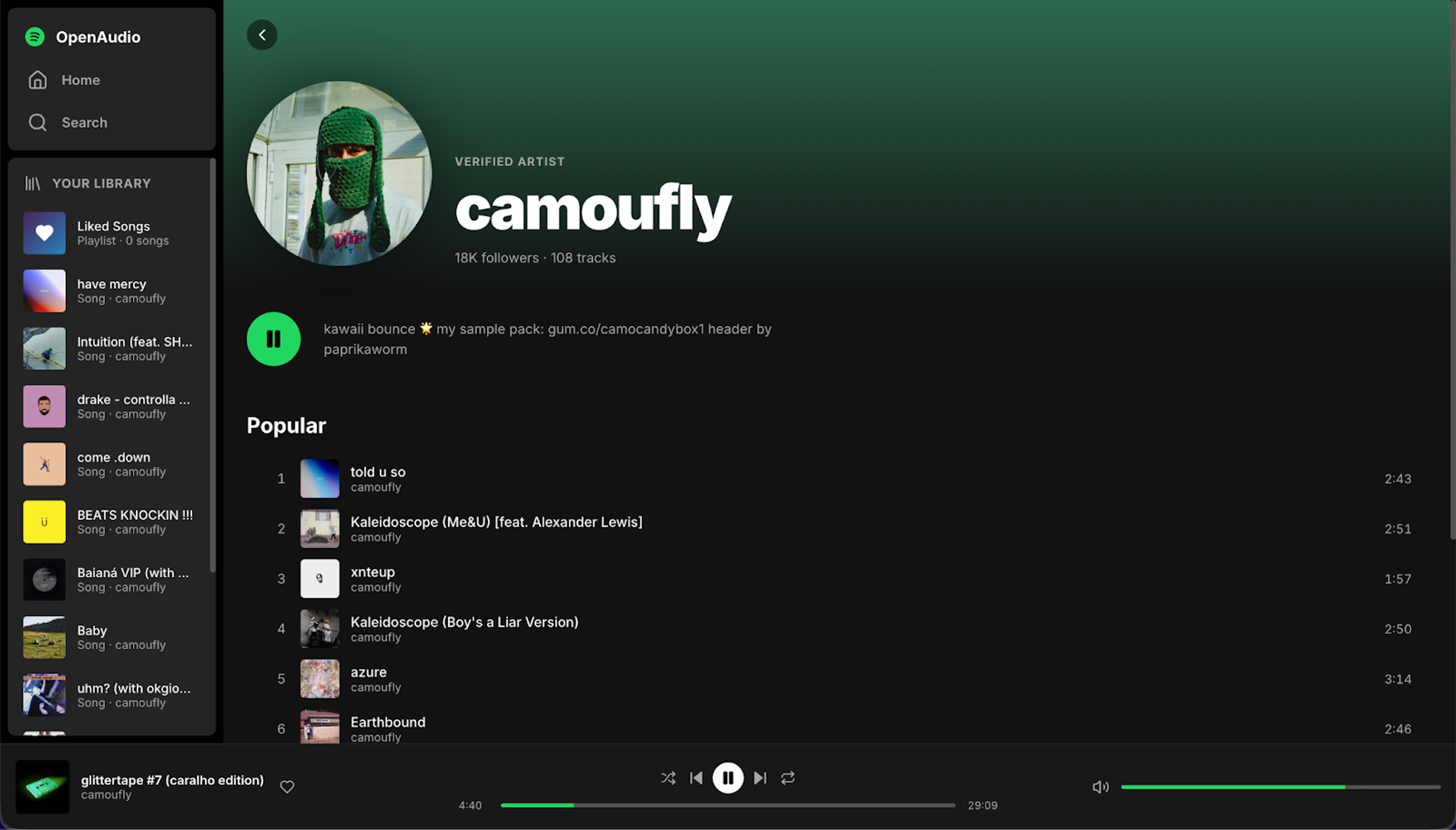
Instant and autonomous software, fueled by the “Cambrian Explosion” of coding agents in 2026, sets the stage for an increased utilization of open and block-chain native protocols. The Open Audio Protocol is the largest open and programmable music catalog in existence and is built for this moment: powering vibecoded applications and agent-native music economies.
Agents Are No Longer Just Chatbots
In recent months, we’ve gone from “AI assistants” to autonomous systems that can launch complete products, run communities, curate feeds, execute transactions, and collaborate with humans in real time. Agents can now author code, write music, and coordinate capital. And what once required full teams with venture funding to launch startups in music now takes no more than impassioned individuals with great ideas.
Through this chapter, one thing is clear: Agents need infrastructure. They need primitives to build on and interfaces to interact with each other and with humans.
If 2026 is the year agents become ubiquitous, it’s also the year we must decide what cultural primitives they are allowed to build with. Music is one of the most powerful datasets on earth. It shapes identity, movements, communities, and economies. But historically, music catalogs have been locked inside platforms: read-only, rate-limited, monetized through opaque policies, and designed primarily for mass-appeal UI.
That model does not adapt to the flexibility of the vibecoder era.
From Streaming To Programmable Catalogs
The streaming era in music was UI-first.
Platforms like Spotify won by building the best consumer experience. They made music instant and searchable. The infrastructure behind the scenes was powerful, but invisible. It existed to serve a single purpose: deliver a seamless listening interface for humans.
That model made sense when distribution was scarce and such interfaces were expensive to build. But we are no longer in that world.
Content creation is now exponential. Tools like Suno, Udio, SongKit, and modern DAWs can help create music at near-zero marginal cost. Interface creation is also instant. Agentic IDEs like Claude Code and Codex can scaffold, ship, and iterate on full products in hours. When both content and interfaces become cheap, the bottleneck shifts. The one-size-fits-all streaming platform stops being the center of gravity and what matters is not the app, but the dataset beneath it. In 2026, you can be in charge of your own music listening experience because you now have the tools to do so.
In a world of infinite music and infinite interfaces, durable leverage lives in the protocol: who can access the catalog, how rights are expressed, how value flows, and how systems compose.
Agents require:
- Machine readable rights and controls
- Composable metadata
- Internet-native financial rails
- Open, permissionless systems
The shift is not just from a Web 2.0 to a Web 3.0, but from a UI-first to an agent-first way of managing information. This requires a fundamentally different technology: a catalog that isn’t just consumable, but programmable by its design. A catalog where rights are encoded, access is deterministic, and commerce is composable. Agents require publicly verifiable data and authentic sources, not walled gardens that lack transparency.
The Open Audio Protocol
The Open Audio Protocol is the largest open, programmable music catalog in existence.
In a world where agents can churn out millions of niche music experiences for human and computer consumers, the backend that succeeds must be permissionless and community governed. Centralized APIs only introduce gatekeeping, monetization choke points, and arbitrary revocation whereas open protocols allow anyone to build, experiment, fork, remix, extend. And by being blockchain-native, governed by $AUDIO, ownership is transparent, payments are programmable, and smart contracts bind interactions to common rules.
The Open Audio Protocol provides novel consumption experiences that are simply not possible with traditional streaming infrastructure that is single-purpose by design.
The Vibecoded Future
If the Cursor creator can whip up an overnight Rollercoaster Tycoon clone (an incredible feat that famously took 2 years of raw assembly programming), spinning up a custom music interface is no longer a significant undertaking. As individuals consume a unique portfolio of music, the interfaces will follow suit.
One app might be an autonomous ambient radio station for late-night coders. Another might be a token-gated hyperpop fan club with dynamic remix rights. Another might be a genre agent that rewires itself based on your onchain identity.
None of these experiences need to replace each other. They will coexist and all need to draw from the same programmable catalog. The vibecoded future will not be owned by a single app, but instead be composed by thousands of builders and agents experimenting at the edges.
Music is the first great cultural dataset to become programmable at global scale and The Open Audio Protocol is that substrate. If you can imagine a music experience, you can now build it. The only constraint is the catalog you build on.
Music was once physical.
It became digital.
Then it became streamable.
Now it is programmable.
Start building: openaudio.org

